

Risks vs. Issues vs. Incidents: Master Project Management Challenges in Tech
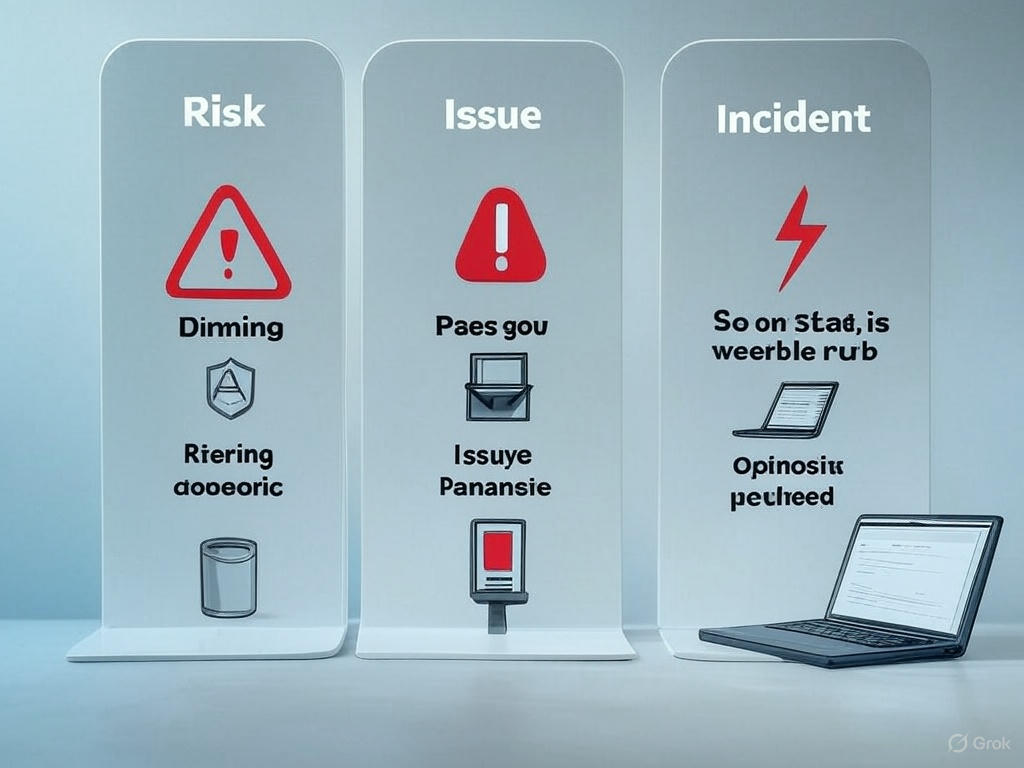
In the dynamic world of project management, navigating uncertainties and challenges is a fundamental part of ensuring successful outcomes. Three terms that often arise in this context—risks, issues, and incidents—are sometimes used interchangeably by those unfamiliar with their nuances. However, each represents a distinct concept with unique implications for a project’s lifecycle.
Grasping these differences is essential for effective planning, execution, and resolution of challenges in any tech-driven project. In this article, we’ll dive deep into what sets risks, issues, and incidents apart, explore their characteristics, and provide real-world examples to illustrate their roles in project management.
Defining the Terms
- Risk
A risk is a potential event or condition that, if it occurs, could have a positive or negative impact on a project’s objectives. Risks are future-oriented and uncertain—they haven’t happened yet, but they might. Project managers identify risks during the planning phase and assess their likelihood and potential impact to devise strategies for mitigation or exploitation (in the case of positive risks).- Key Characteristics:
- Uncertain and probabilistic.
- Can be positive (opportunities) or negative (threats).
- Managed proactively through risk management plans.
- Identified before they materialize.
- Key Characteristics:
- Issue
An issue is a current problem—something that has already occurred and is actively affecting the project. Unlike risks, issues are not hypothetical; they demand immediate attention and resolution to minimize their impact on project goals.- Key Characteristics:
- Real and present.
- Typically negative in impact.
- Requires reactive management.
- Often escalates from an unmanaged or unidentified risk.
- Key Characteristics:
- Incident
An incident is an unexpected event that disrupts normal operations or processes within a project. Incidents are typically sudden and unplanned, often requiring urgent action to restore stability. In tech projects, incidents are frequently associated with IT systems, such as outages or security breaches.- Key Characteristics:
- Sudden and disruptive.
- Often tied to operational or technical failures.
- Managed reactively, often through predefined incident response protocols.
- May lead to issues if not resolved quickly.
- Key Characteristics:
The Core Differences
To better understand how risks, issues, and incidents differ, let’s break them down across key dimensions:
| Aspect | Risk | Issue | Incident |
|---|---|---|---|
| Timing | Future (potential) | Present (already happening) | Sudden (unexpected event) |
| Nature | Uncertain | Known and active | Disruptive and unplanned |
| Management Approach | Proactive (prevent or prepare) | Reactive (resolve) | Reactive (respond and recover) |
| Impact | Possible (positive or negative) | Actual (usually negative) | Immediate (often negative) |
| Example | Delay due to potential vendor issues | Vendor missed a deadline | Server crash during testing |
- Timing: Risks are about what could happen, issues are about what is happening, and incidents are about what just happened unexpectedly.
- Management: Risks are anticipated and mitigated ahead of time, while issues and incidents require immediate action after they arise.
- Scope: Risks can be opportunities or threats, whereas issues and incidents are almost always negative in their immediate effect.
Why These Distinctions Matter in Tech Projects
In technology projects—whether developing software, deploying infrastructure, or managing cybersecurity—these distinctions guide how teams allocate resources, prioritize tasks, and communicate with stakeholders. Misidentifying a risk as an issue, or an incident as a risk, can lead to inefficient responses, wasted time, or even project failure. For instance:
- Failing to mitigate a risk might allow it to become an issue.
- Treating an incident as a mere issue without urgency could escalate its damage.
- Ignoring an issue might trigger a cascade of incidents.
Effective project management hinges on recognizing these categories and applying the right tools and processes to address them.
Detailed Examples in a Tech Project Context
Let’s explore these concepts through a hypothetical software development project: building a customer relationship management (CRM) system for a mid-sized company.
- Risk Example
- Scenario: During the planning phase, the project team identifies that their third-party API provider might experience downtime during peak usage periods, which could delay integration testing.
- Details: This is a risk because it hasn’t happened yet—it’s a possibility based on past vendor performance data. The likelihood is estimated at 30%, with a moderate impact on the timeline.
- Management: The team proactively mitigates this risk by negotiating a backup API provider and scheduling testing during off-peak hours. A risk register is updated, and contingency plans are documented.
- Outcome: If the downtime occurs, the team is prepared; if it doesn’t, the project proceeds smoothly.
- Issue Example
- Scenario: Two weeks before the CRM launch, the lead developer reports that a critical feature (real-time analytics) is incomplete due to a miscommunication about requirements.
- Details: This is an issue because it’s a present problem—the feature isn’t ready, and it’s already affecting the project timeline and client expectations. It may have stemmed from an untracked risk (e.g., unclear requirements), but now it’s real.
- Management: The project manager reacts by reallocating resources, negotiating a scope adjustment with the client, and scheduling overtime to resolve the issue before launch. An issue log tracks progress.
- Outcome: The issue is resolved with minor delays, but it highlights the need for better requirement validation in future projects.
- Incident Example
- Scenario: During the final week of testing, a ransomware attack encrypts the CRM’s staging server, halting all progress.
- Details: This is an incident because it’s an unexpected, disruptive event that occurred suddenly. It wasn’t planned for in the risk register (though cybersecurity threats could have been a risk), and it requires immediate action.
- Management: The IT team activates an incident response plan, isolating the affected server, restoring data from backups, and investigating the breach. The project manager informs stakeholders of the delay.
- Outcome: The incident is contained, but it evolves into an issue—a delayed launch—requiring further management.
How They Interconnect
In practice, risks, issues, and incidents often overlap or transition into one another:
- A risk that isn’t mitigated (e.g., “the vendor might delay delivery”) can become an issue (“the vendor has delayed delivery”).
- An incident (e.g., a server crash) can create an issue (e.g., “testing is now behind schedule”) if its effects linger.
- An unresolved issue (e.g., “the team lacks training on a new tool”) might trigger an incident (e.g., a critical error during deployment).
This interplay underscores the importance of a holistic project management approach that integrates risk assessment, issue tracking, and incident response.
Best Practices for Managing Risks, Issues, and Incidents
- Risk Management
- Conduct regular risk assessments using tools like SWOT analysis or probability-impact matrices.
- Maintain a risk register to track potential risks, their triggers, and mitigation plans.
- Example Tool: PMI’s Risk Management Framework or software like Jira for tracking.
- Issue Management
- Establish an issue log to document problems, assign ownership, and monitor resolution timelines.
- Hold daily stand-ups or escalation meetings to address issues promptly.
- Example Tool: Trello or Microsoft Project for issue tracking.
- Incident Management
- Develop an incident response plan tailored to tech-specific disruptions (e.g., outages, breaches).
- Conduct post-incident reviews to identify root causes and prevent recurrence.
- Example Tool: ITIL-based frameworks or platforms like PagerDuty.
Conclusion
In the fast-paced realm of tech project management, distinguishing between risks, issues, and incidents is more than an academic exercise—it’s a practical necessity. Risks require foresight and preparation, issues demand swift resolution, and incidents call for rapid response.
By understanding their differences and interconnections, project managers can build resilient strategies that keep projects on track, even in the face of uncertainty. Whether you’re coding the next big app or deploying enterprise infrastructure, mastering these concepts ensures you’re equipped to handle whatever comes your way—before, during, or after it happens.
Read more🌐 about latest Tech updates on out Technology Category Section
#ProjectManagement #TechProjects #RiskManagement #IssueResolution #IncidentResponse #PMTips #TechLeadership