


AI Engineer Roadmap: A Step-by-Step Guide to Becoming an AI Engineer
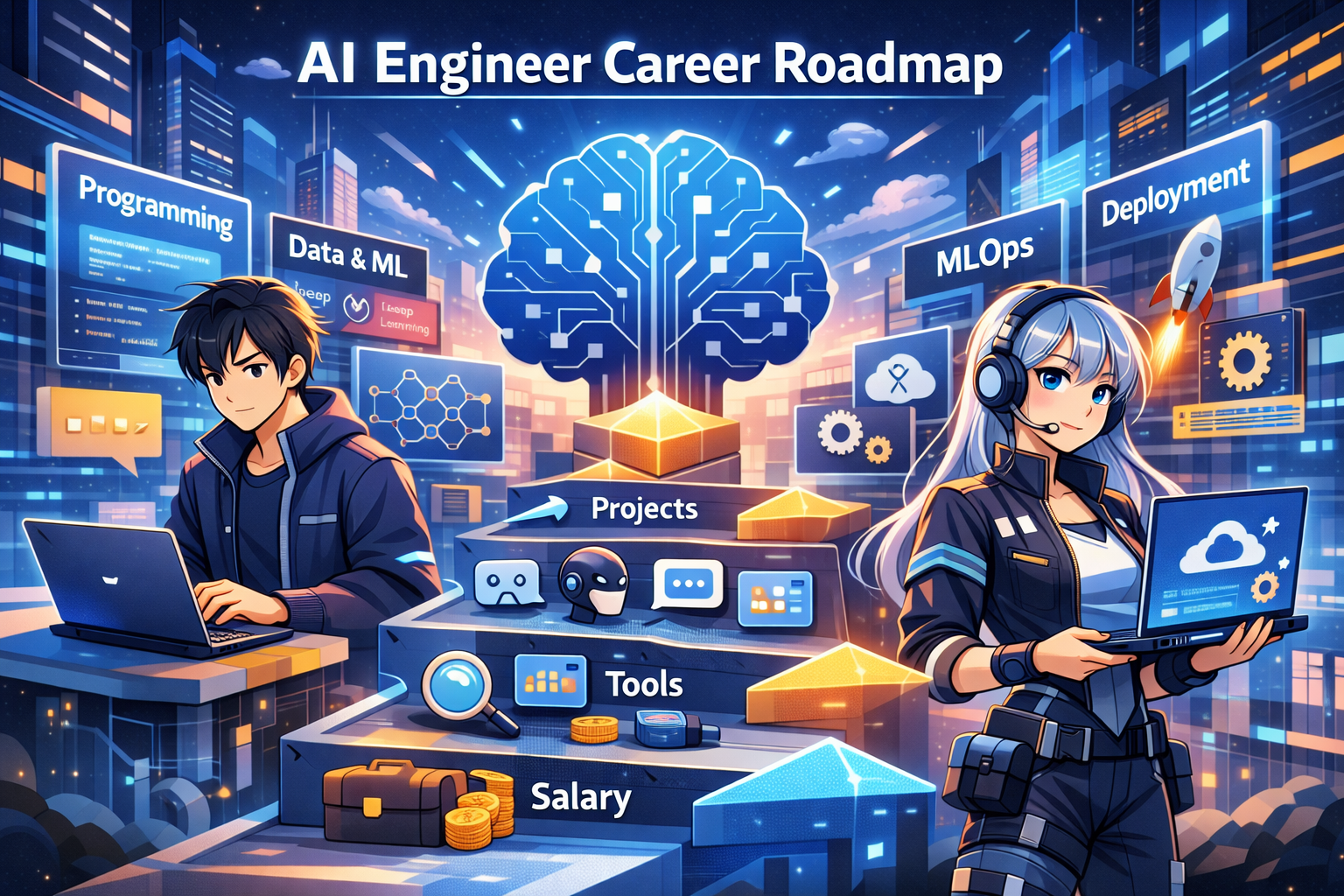
AI Engineers sit at the heart of modern technology — building systems that learn, reason, and act. From recommendation engines and chatbots to autonomous systems and enterprise automation, AI Engineers turn theory into real-world impact – AI engineer roadmap.
But the field can feel overwhelming.
This roadmap breaks the journey into clear, achievable stages, so you know:
- What to learn
- In what order
- And why it matters
What Does an AI Engineer Do?
An AI Engineer:
- Builds and deploys machine learning models
- Works with data pipelines and infrastructure
- Integrates AI into applications and products
- Optimises models for performance and scale
- Collaborates with product, backend, and data teams
AI Engineers focus less on research and more on production-ready AI systems.
Stage 1: Strong Foundations (0–6 Months)
Before AI, you need solid fundamentals.
1. Programming (Must-Have)
Focus on:
- Python (primary language for AI)
- Basic data structures and algorithms
- Writing clean, readable code
Python is non-negotiable in AI engineering.
2. Mathematics for AI (Conceptual, Not Heavy)
You don’t need a PhD — but you must understand:
- Linear algebra (vectors, matrices)
- Probability and statistics
- Basic calculus (gradients, optimisation intuition)
This helps you understand why models behave the way they do.
Stage 2: Core Machine Learning (6–12 Months)
This is where AI engineering truly begins.
3. Machine Learning Fundamentals
Learn:
- Supervised vs unsupervised learning
- Regression, classification, clustering
- Model evaluation metrics
- Overfitting vs underfitting
Tools:
- scikit-learn
- pandas, NumPy
4. Data Handling & Feature Engineering
AI models are only as good as the data.
Learn:
- Data cleaning and preprocessing
- Feature selection and transformation
- Handling missing and noisy data
This is a core AI engineering skill, often underrated.
Stage 3: Deep Learning & Modern AI (12–18 Months)
5. Neural Networks & Deep Learning
Focus on:
- Feedforward networks
- CNNs (computer vision)
- RNNs & transformers (NLP)
Frameworks:
- PyTorch
- TensorFlow (secondary)
6. Large Language Models (LLMs)
Modern AI engineers must understand:
- How LLMs work conceptually
- Prompt engineering
- Fine-tuning basics
- Inference optimisation
LLMs are now part of mainstream AI systems.
Stage 4: AI Engineering in Production (18–24 Months)
This is what separates learners from professionals.
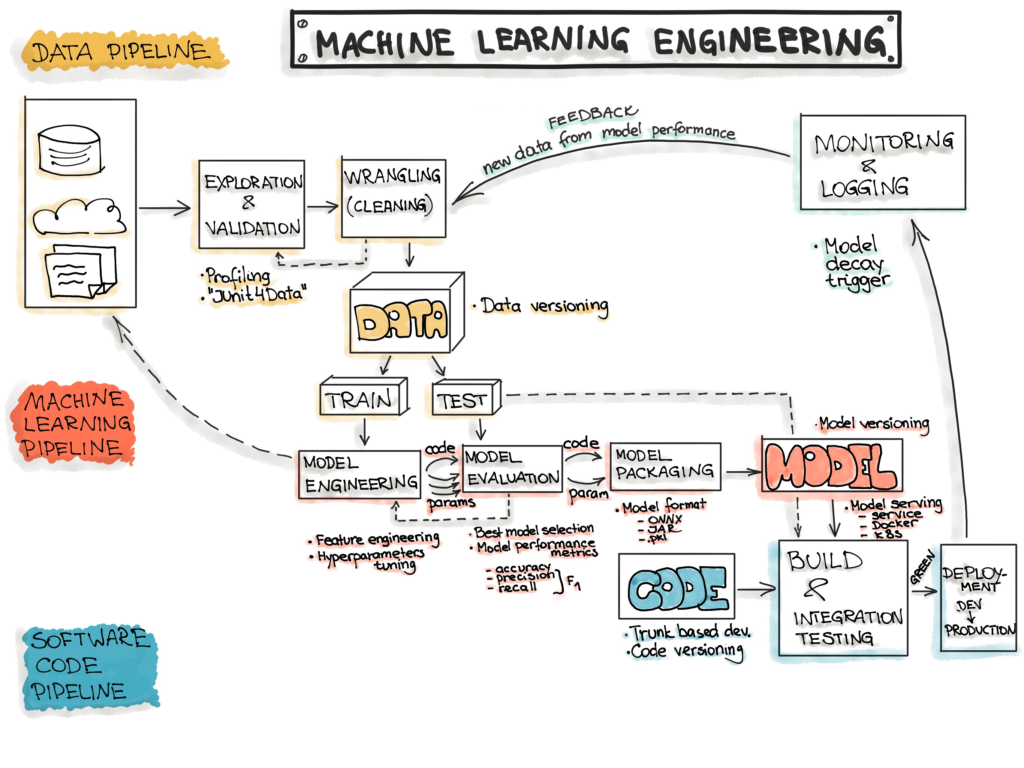
7. MLOps & Deployment
Learn how models go live:
- Model versioning
- Experiment tracking
- CI/CD for ML
- Monitoring and retraining
Tools:
- MLflow
- Docker
- Kubernetes (basic)
- Cloud platforms
8. APIs & System Integration
AI Engineers don’t work in isolation.
Learn:
- REST APIs
- Model serving
- Backend integration
- Performance optimisation
This enables real-world AI products.
Stage 5: Advanced & Specialisation (2+ Years)
Choose one or two areas to go deeper.
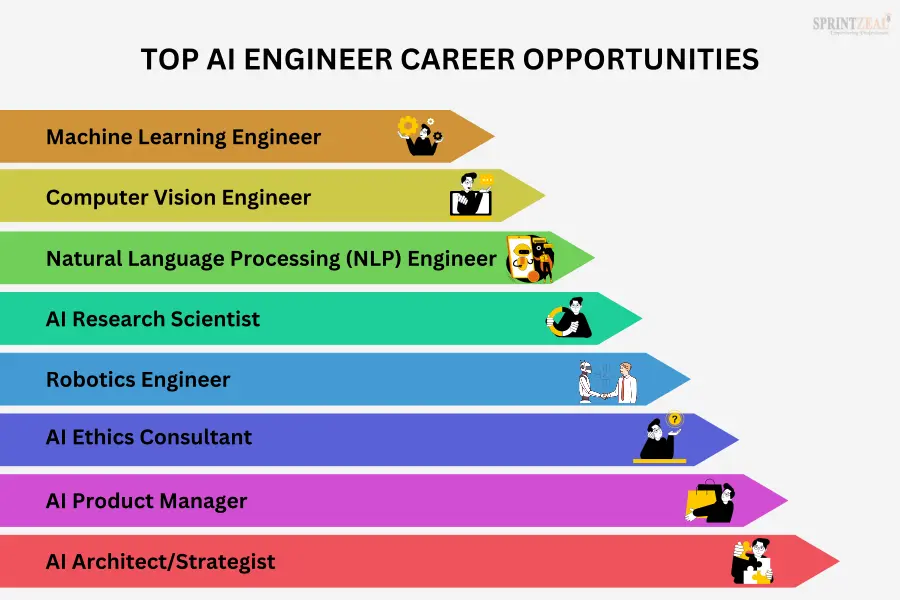
Popular Specialisations
- NLP & LLM systems
- Computer Vision
- Recommendation systems
- AI agents & autonomous systems
- Applied AI for fintech, healthcare, SaaS
Depth > breadth at this stage.
Essential Tools Every AI Engineer Should Know
- Python
- PyTorch
- SQL
- Git
- Docker
- Cloud platforms (AWS / GCP / Azure)
- Basic Linux
You don’t need mastery — just working proficiency.
Projects You Should Build (Very Important)
Employers value proof, not certificates.
Example Projects
- Recommendation engine
- Chatbot using an LLM
- Image classifier
- Fraud detection model
- End-to-end ML pipeline
Document your work clearly on GitHub.
Certifications (Optional, Not Mandatory)
Certifications can help with structure, not jobs.
Useful ones:
- Machine Learning certifications (platform-based)
- Cloud AI certifications
- Applied AI programs from reputed institutions
Avoid courses promising guaranteed AI jobs.
AI Engineer Salary Outlook (2026 Estimates)
India
- Entry-level: ₹12 – 25 LPA
- Mid-level: ₹25 – 45 LPA
- Senior AI Engineer: ₹50 LPA – ₹1 Cr+
US / Global
- Entry-level: $110k – $140k
- Senior: $180k – $250k+
AI Engineers with production experience earn the most.
Companies Hiring AI Engineers
- Big Tech (Google, Microsoft, Amazon)
- AI-first startups
- SaaS companies
- Fintech & Healthtech
- Research labs & applied AI teams
Demand continues to outpace supply.
Common Mistakes to Avoid
- Skipping fundamentals
- Learning tools without understanding concepts
- Avoiding deployment and MLOps
- Collecting certificates instead of building projects
AI engineering is about systems, not just models.
You can also use the Roadmap site to get a detailed blueprint
Final Thoughts
Becoming an AI Engineer is a marathon, not a sprint.
If you:
- Build strong foundations
- Learn progressively
- Focus on real-world systems
- Keep shipping projects
You’ll be well-positioned for one of the most future-proof careers in tech -AI engineer roadmap.
Also read our article on LLMs and Agentic AI Explained: How GPT Models Really Work
#AIEngineer #AIRoadmap #MachineLearning #DeepLearning #LLM #MLOps #TechCareers #FutureSkills