
Hard Skills vs Soft Skills in 2026: What Employers Actually Value Today
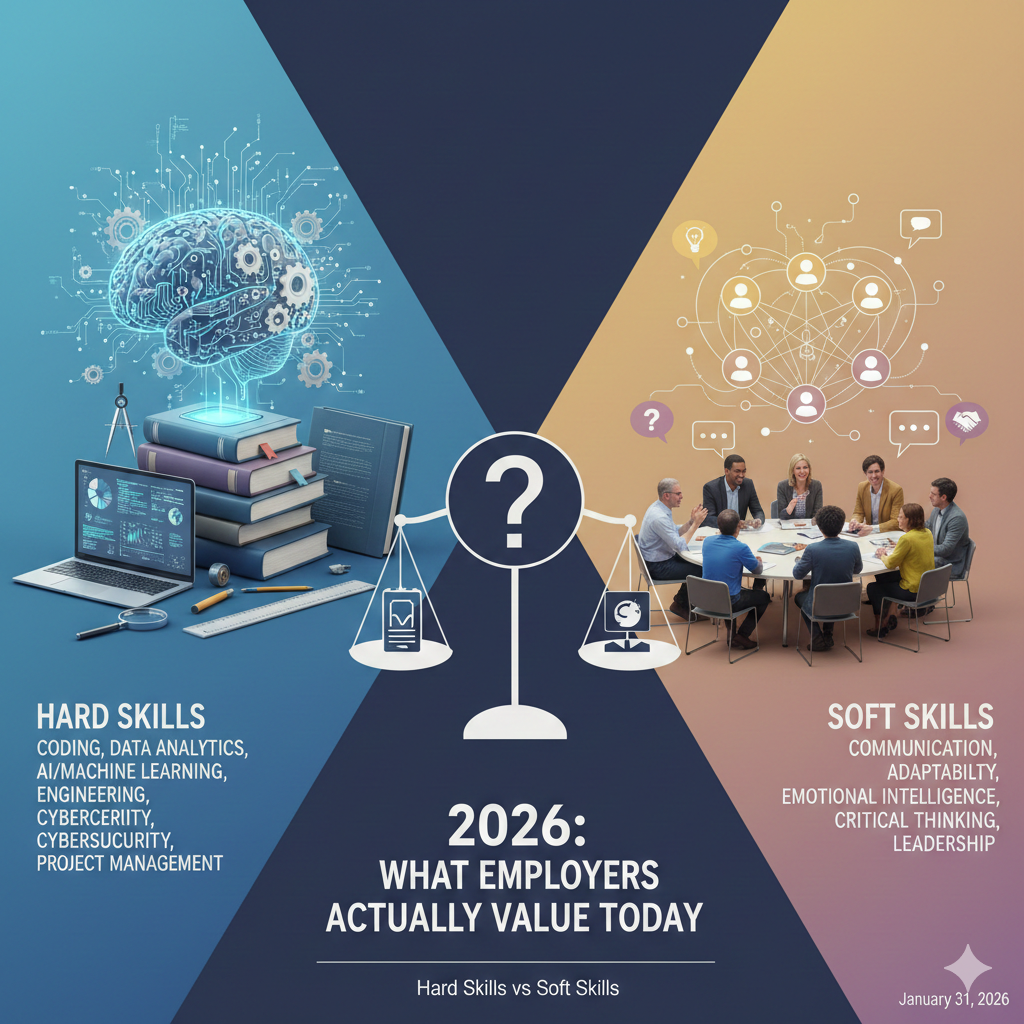
In 2026, careers are no longer built on degrees alone. They’re built on skills that survive automation, AI, and constant change (Skills employers want 2026).
Yet many professionals still ask the wrong question: Should I focus on hard skills or soft skills?
The truth is simpler — and more important. Employers don’t hire either.
They hire people who combine both in the right way.
Let’s break it down clearly.
What Are Hard Skills?
Hard skills are technical, measurable abilities that can be taught, tested, and verified.
Examples of Hard Skills in 2026
- Data analysis and interpretation
- AI and automation tool usage
- Programming and technical workflows
- Digital marketing and analytics
- Financial modeling and forecasting
Hard skills answer one question:
Can you do the job?
They help you get shortlisted.
What Are Soft Skills?
Soft skills are human capabilities that determine how effectively you apply your knowledge.
Examples of Soft Skills in 2026
- Communication and clarity
- Critical thinking
- Decision-making
- Emotional intelligence
- Leadership and collaboration
Soft skills answer a deeper question:
Can we trust you with responsibility?
They help you get promoted and retained.
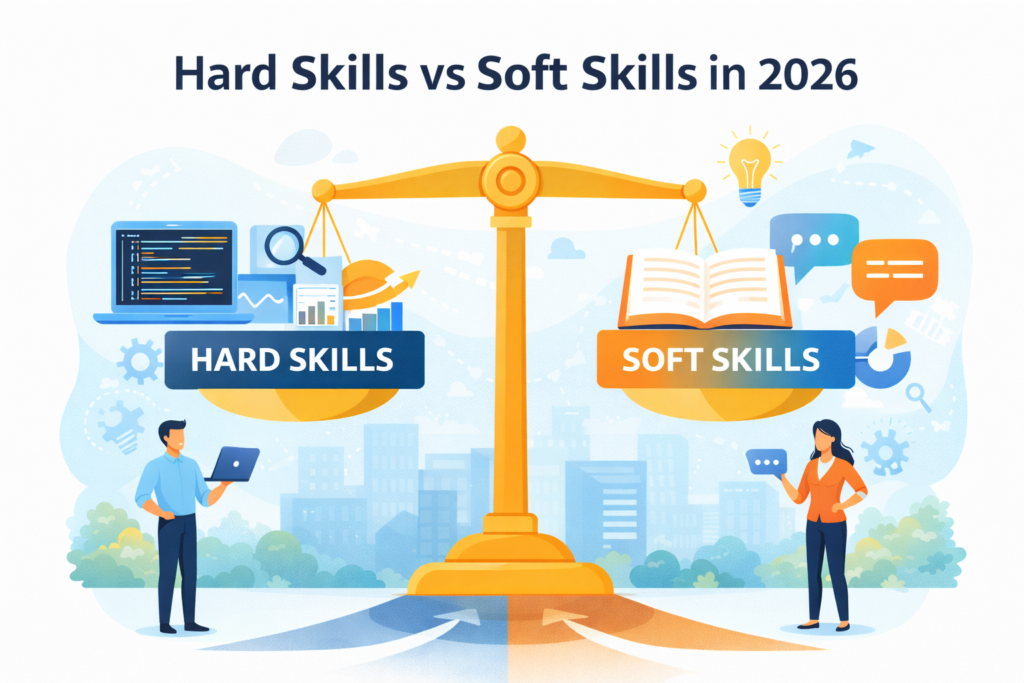
What Changed in 2026?
1. AI Reduced the Value of Pure Execution
Tasks that are:
- Repetitive
- Rule-based
- Predictable
are increasingly automated.
This means technical skill alone is no longer enough.
2. Human Judgment Became More Valuable
AI can generate answers.
It cannot:
- Understand context fully
- Handle ambiguity
- Take ethical responsibility
This is where soft skills dominate.
3. Employers Want “T-Shaped” Professionals
In 2026, companies prefer people who have:
- Depth in one hard skill
- Breadth in human and strategic skills
This combination creates resilience.
What Employers Actually Value Most (The Real Priority)
1. Hard Skills Get You Hired
2. Soft Skills Keep You Employed
3. Skill Combination Gets You Promoted
Employers repeatedly rank these as critical:
- Problem-solving
- Communication
- Adaptability
- Decision-making under uncertainty
Not because they sound nice — but because they cannot be automated easily.
High-Demand Skill Combinations for 2026
Here’s what works best:
🔹 Technical + Human
- Data analysis + communication
- AI tools + critical thinking
- Coding + product thinking
🔹 Business + Soft Skills
- Finance + decision-making
- Operations + leadership
- Marketing + storytelling
The more intersections you operate in, the safer your career.
Skills That Are Becoming Risky If Unbalanced
Be cautious if you rely only on:
- Technical execution without context
- Tools without understanding outcomes
- Individual contribution without collaboration
These roles face the highest disruption risk.
How to Build the Right Skill Mix (Practical Framework)
Step 1: Strengthen One Core Hard Skill
Choose something that:
- Has long-term demand
- Applies across industries
Examples: data, AI tools, finance, technology.
Step 2: Add One Human Multiplier Skill
Examples:
- Writing clearly
- Presenting ideas
- Decision-making
This multiplies your technical value.
Step 3: Practice Skills in Real Situations
Employers trust:
- Projects
- Case studies
- Real outcomes
Not certificates alone.
Final Thoughts
In 2026, the debate is no longer hard skills vs soft skills – Skills employers want 2026.
The real question is:
Can you combine technical ability with human judgment?
Those who can will:
- Survive layoffs better
- Grow faster
- Lead sooner
Skills age.
Skill combinations endure.
Also, Read our article on Google Antigravity IDE Explained
#CareerSkills #FutureOfWork #Upskilling #ProfessionalGrowth #Skills2026 #Learning