


LLMs and Agentic AI Explained: How GPT Models Really Work
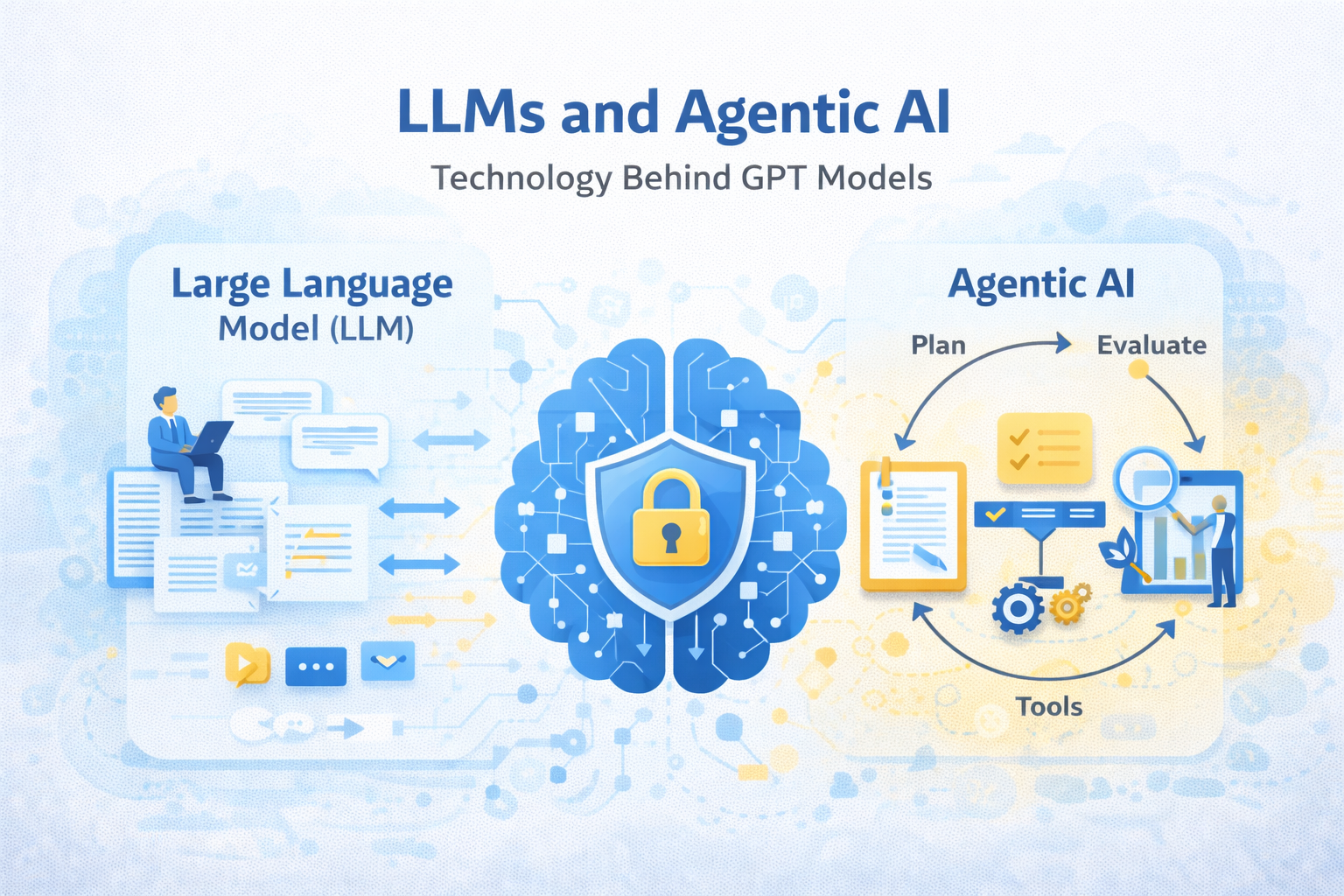
Terms like LLM, Agentic AI, and GPT are now everywhere — but they’re often explained in ways that sound mysterious or overly complex – GPT technology.
In reality, these technologies follow clear principles.
This article breaks down:
- What an LLM actually is
- What Agentic AI means
- How GPT models work under the hood
- Why this shift matters for the future of technology
No math. No jargon overload. Just clarity.
What Is an LLM (Large Language Model)?
An LLM (Large Language Model) is an AI system trained to understand, generate, and reason with human language.
At its core, an LLM learns patterns in text by studying massive amounts of data — books, articles, code, conversations, and more.
What LLMs Can Do
- Answer questions
- Write content
- Summarise documents
- Translate languages
- Generate and explain code
- Reason across multiple topics
They don’t “know” facts like humans do —
they predict the most likely next word based on context.
How LLMs Learn Language (Simply Explained)
LLMs are trained using a process called self-supervised learning.
That means:
- The model sees text
- Some words are hidden
- The model learns to predict them
- It repeats this process billions of times
Over time, it learns:
- Grammar
- Meaning
- Relationships between concepts
- Logical structure in language
This training happens at enormous scale, using powerful computing infrastructure.
The Transformer: The Core Technology Behind GPTs
The key breakthrough behind modern LLMs is the Transformer architecture.
What Makes Transformers Special?
Instead of reading text word by word like older models, transformers:
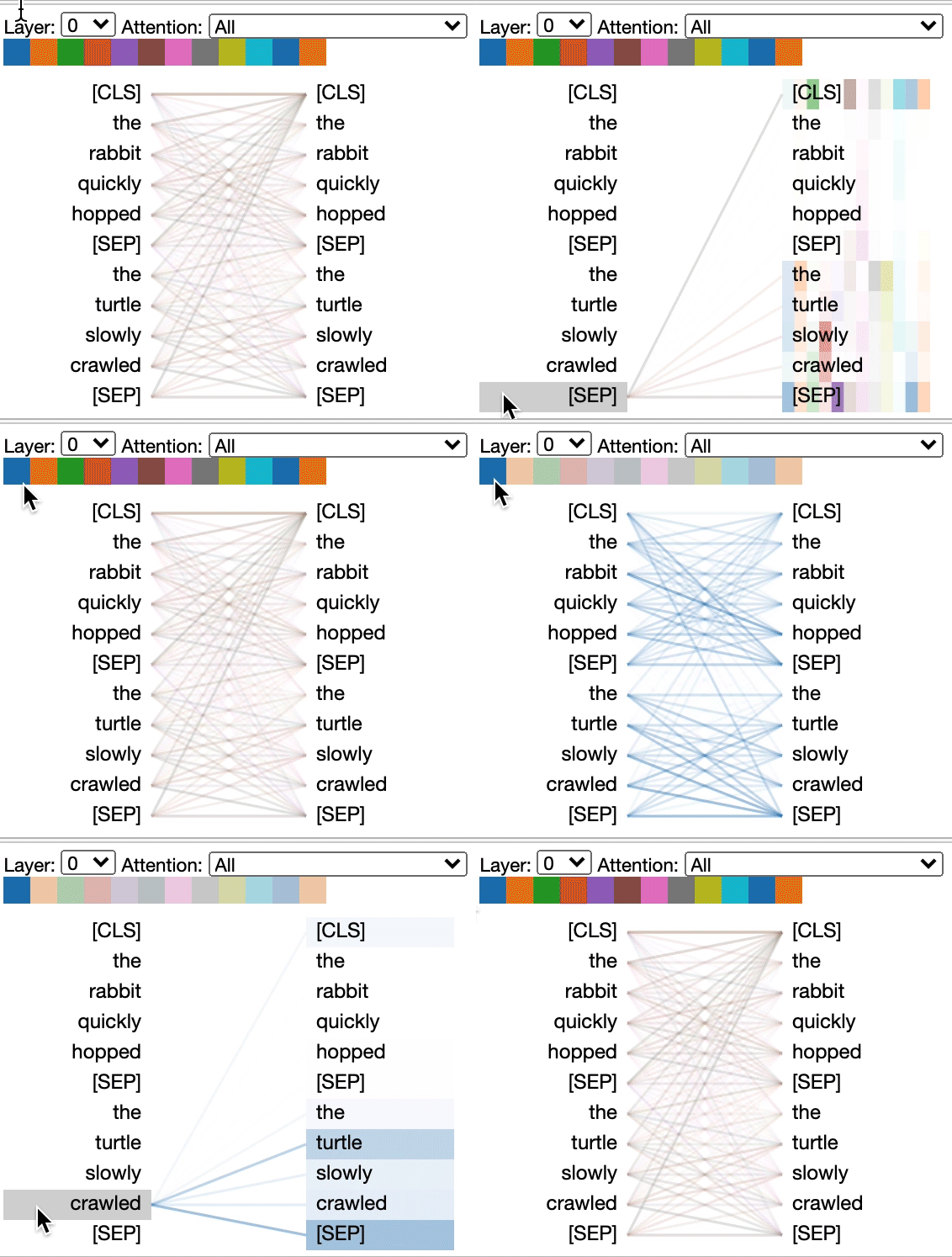
- Look at entire sentences at once
- Understand context and relationships
- Focus attention on the most important words
This mechanism is called attention.
Why Attention Matters
It allows the model to:
- Understand long conversations
- Maintain context
- Reason across paragraphs
- Handle complex instructions
GPT models are built entirely on this transformer architecture.
What Is GPT, Exactly?
GPT (Generative Pre-trained Transformer) is a type of LLM that:
- Is pre-trained on massive text data
- Learns general language patterns
- Is later refined to follow instructions and be helpful
“Generative” means it can create new text, not just analyse existing text.
Each new GPT version improves:
- Reasoning ability
- Accuracy
- Instruction-following
- Safety and alignment
From LLMs to Agentic AI: The Next Evolution
LLMs alone are powerful — but they are reactive.
They respond to prompts.
Agentic AI goes a step further.
What Is Agentic AI?
Agentic AI refers to AI systems that can:
- Set goals
- Plan steps
- Use tools
- Take actions
- Evaluate results
- Iterate until a task is complete
Instead of just answering questions, an AI acts like an agent.
How Agentic AI Works (In Simple Terms)
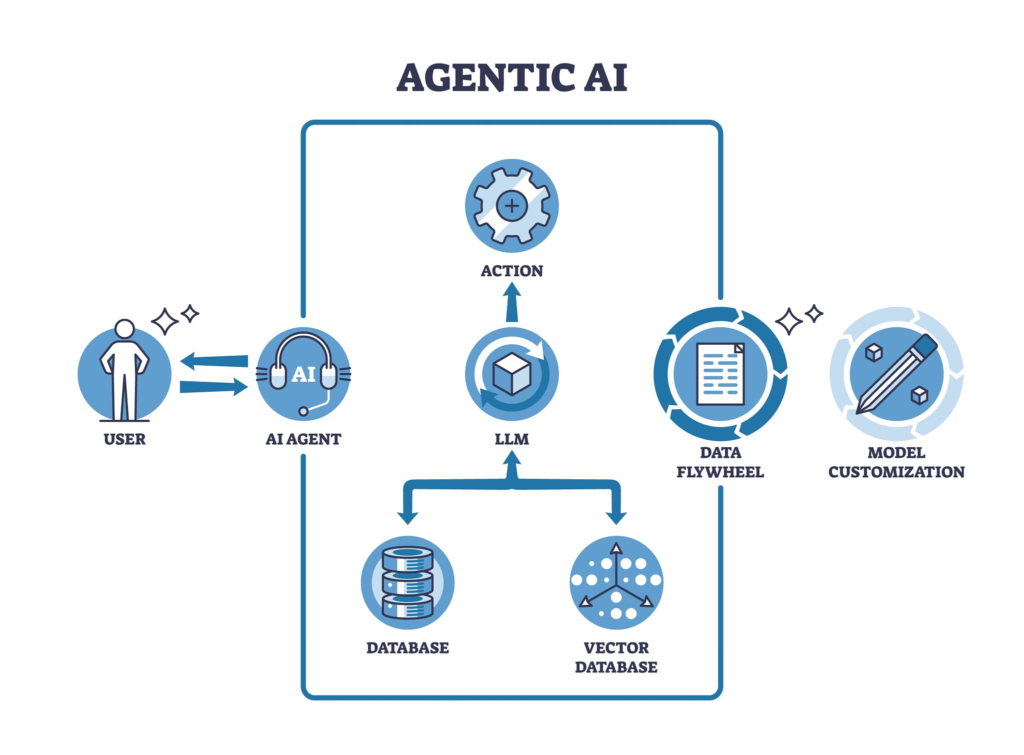
An agentic system typically follows a loop:
- Goal understanding – What needs to be done?
- Planning – What steps are required?
- Tool use – APIs, search, code, databases
- Execution – Perform actions
- Evaluation – Did it work?
- Iteration – Improve or retry
LLMs act as the brain, while tools provide capabilities.
LLM vs Agentic AI: Key Difference
| Feature | LLM | Agentic AI |
|---|---|---|
| Responds to prompts | Yes | Yes |
| Plans multi-step tasks | Limited | Yes |
| Uses tools | No (by default) | Yes |
| Takes actions | No | Yes |
| Works autonomously | No | Partially |
Agentic AI = LLM + memory + tools + planning logic
Why Agentic AI Is a Big Deal
Agentic AI enables:
- Autonomous research
- Software development agents
- Workflow automation
- Data analysis pipelines
- Business process execution
This is how AI moves from assistant to collaborator.
Real-World Examples (Conceptual)
- An AI that plans and books a trip end-to-end
- An AI that analyses data, writes a report, and emails it
- An AI that debugs code, runs tests, and fixes errors
- An AI that manages tasks across multiple systems
These are not sci-fi — they’re emerging now.
Limitations and Risks to Understand
Despite progress, these systems:
- Can make confident mistakes
- Depend heavily on data quality
- Require strong safeguards
- Need human oversight
Agentic AI is powerful — but not autonomous intelligence.
Key takeaways:
LLMs like GPT changed how machines understand language. Agentic AI is changing how machines act– GPT technology.
Together, they represent a shift from:
- AI as a tool
→ AI as a system that reasons, plans, and executes
Understanding this foundation is key to understanding the future of technology.
Also read our article on – Hostinger vs Bluehost vs GoDaddy (2026 Comparison): Best Web & WordPress Hosting Reviewed